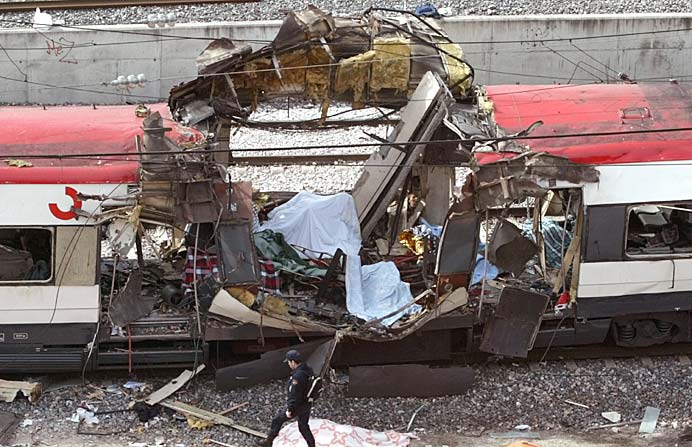
Spanish authorities initially blamed the Basque separatist group ETA. But after finding a van near Madrid with detonators and a tape of Koran verses, they held open the possibility of Islamic terrorism. A group claiming links to Al Qaeda took responsibility for the attacks in a letter delivered to an Arabic newspaper, but an American counterterrorism official said the claim should be viewed skeptically.
Spain, an American ally in the war on Iraq, has 1,300 troops stationed there and was explicitly threatened in an audiotape last October reportedly made by Osama bin Laden. As the country struggled to absorb the devastation, three days before general elections, Prime Minister José María Aznar said, ``March 11 now has its place in the history of infamy.'' The bombings came in coordinated explosions within a 10-minute period shortly before 8 a.m. The police found and detonated three other bombs.
At the main Atocha commuter station in the heart of Madrid, just a block from the Prado Museum, an explosion cut a train in two, sending pieces of metal high into the air. Bloody victims crawled from mangled train cars and staggered into the streets. Other victims were found burned to death in their seats. There, and at the nearby Santa Eugenia and El Pozo stations, broken bodies and body parts were thrown along the platforms as rescue workers struggled to separate the dead from the wounded. Amet Oulabid, a 23-year-old carpenter, said he got off the front of the train at the Atocha station just seconds before the bomb went off in one of its rear cars. ``I saw bodies flying,'' he said. ``There was a security guard dripping with blood. People were pushing and running. I saw a woman who had fallen on the tracks because people were pushing so hard. I escaped with my life by a hair.'' At El Pozo, just east of downtown Madrid, Luz Elena Bustos, 42, got off a nearby bus just 10 minutes before the explosion at that station. ``There were pieces of flesh and ribs all over the road,'' she said. ``There were ribs, brains all over. I never saw anything like this. The train was blown apart. I saw a lot of smoke, people running all over, crying.'' People combed the city's major hospitals in search of family members who they thought were aboard the trains. ``Oh, please, God! This can't be happening,'' said Carmen Gómez, 47, sobbing as she studied a patient list in vain at Gregorio Marañon Hospital, seven hours after the terrorist attack. ``How could a human being do this?''
Most of the victims were ordinary middle- and working-class people and university students commuting into Madrid, though children were also among the dead. Spanish authorities immediately pointed to the Basque group ETA, which has been seeking independence for more than three decades. ``It is absolutely clear that the terrorist organization ETA was seeking an attack with wide repercussions,'' Interior Minister Ángel Acebes told a hastily called news conference. But later, he was less categorical, after investigators found the van with the detonators and the Koran tape. The van, which had been stolen in Madrid on Feb. 28, was found in Alcalá de Henares, the birthplace of Cervantes, which was the departure point for three of the four trains bombed on Thursday morning. ``Because of this, I have just given instructions to the security forces not to rule out any line of investigation,'' Mr. Acebes said. But he added that ETA remained the ``main line of investigation.'' He said more than 220 pounds of dynamite packed into backpacks was used in the attacks.
Arnaldo Otegi, leader of Batasuna, ETA's political wing, which has been banned in Spain, said ETA probably was not behind the attacks. He said the attack could have been the work of ``Arab resistance.'' Another senior Spanish official said in an interview that the bombs used titadine, a kind of compressed dynamite found in a van containing 1,100 pounds of explosives that was intercepted last month as it headed for Madrid. Two suspected ETA members were arrested at the time. The official added that the government believed the dynamite was stolen from France three years ago. ``This material has a kind of signature on it,'' the official said. On Dec. 24, the police foiled a plot that would have detonated two bombs in a train after it arrived at a Madrid station. They seized a man with a bomb in San Sebastián, a Basque city. He had a ticket for the train, and when the police halted the train and searched it, they found a second bomb.
The letter claiming responsibility for the attack on Thursday was delivered to Al Quds Al Arabi, a London-based Arab newspaper. It also said an attack on the United States was on the final stages of preparation. ``We bring the good news to Muslims of the world that the expected `winds of black death' strike against America is now in its final stage,'' the letter said, adding that the strike was ``90 percent'' ready ``and, God willing, near.'' The government declared a three-day period of mourning and political parties called off all remaining campaign events, although the elections will proceed Sunday as scheduled.
On Thursday evening, Prime Minister Jean-Pierre Raffarin of France raised the terrorism alert level in France from yellow to orange, meaning that a criminal or terrorist attack is considered possible.
nytimes

